
AI DIGITAL MARKETING 2026
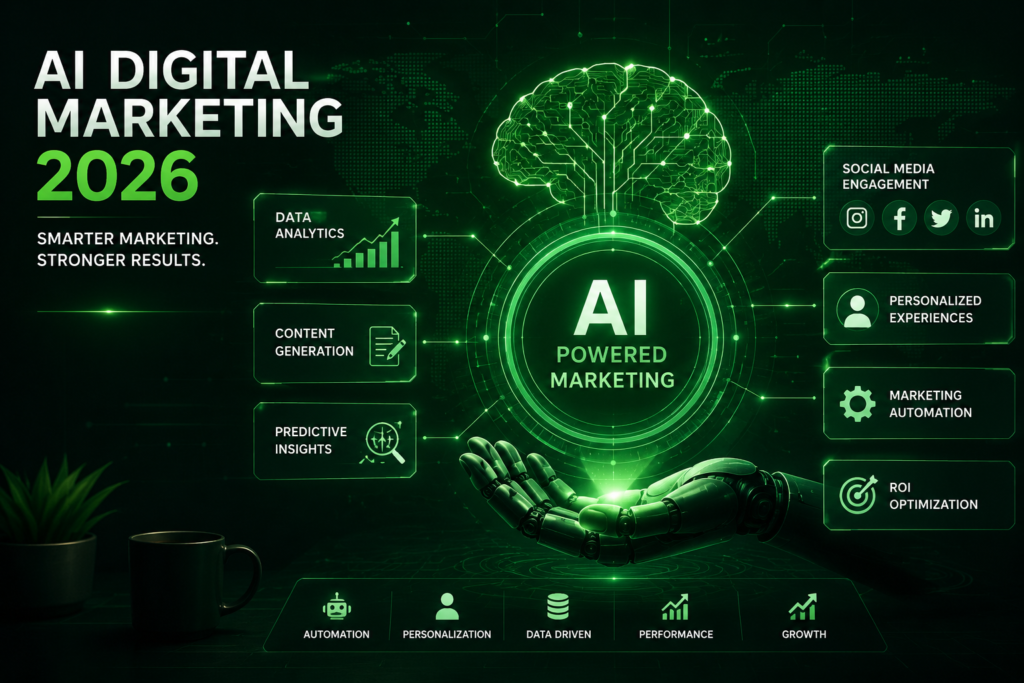
How AI is Transforming Digital Marketing in 2026
AI DIGITAL MARKETING 2026
Introduction
Digital marketing has always changed with the advancement of technology, but the rise of Artificial Intelligence (AI) has completely changed how brands interact with their audiences.
In 2026, AI is no longer just a helpful tool—it is the main part of modern marketing strategies.From creating content and engaging with customers to analyzing data and personalizing experiences, AI is forming a more intelligent, efficient, and customer-focused marketing environment.
For businesses, marketers, and content creators, understanding how AI is changing digital marketing is not optional—it is necessary to stay competitive.
This blog explores how AI is transforming digital marketing in 2026, the main trends driving this change, and how you can adapt to be successful in this new world.
The Growth of AI in Digital Marketing
AI DIGITAL MARKETING 2026
AI has moved far beyond just doing simple tasks.
In the past, it was mainly used for scheduling posts or checking basic stats.Today, AI systems can predict what customers might do, create high-quality content, offer personalized experiences, and improve campaigns in real time.
The reason for this quick adoption is simple: AI saves time, improves how work is done, and leads to better results.
Businesses can now make smart decisions based on data faster than ever, allowing them to stay ahead in a very competitive digital world.
Hyper-Personalization at Scale
AI DIGITAL MARKETING 2026
One of the biggest changes AI has brought to digital marketing is hyper-personalization.
In 2026, generic marketing no longer works.Customers expect brands to understand their likes, habits, and needs.
AI uses user data such as what they look at online, what they buy, and how they engage with content to give personalized messages.
This includes:
* Personalized email campaigns
* Product suggestions
* Custom website experiences
* Tailored social media posts
For example, when a user visits a website, AI can instantly change the content they see based on what interests them.
This makes the experience more engaging and relevant, which can help increase conversions.
Hyper-personalization not only makes customers more satisfied but also helps in building stronger brand loyalty.
AI-Powered Content Creation
AI DIGITAL MARKETING 2026
Content is still very important, but AI has changed how content is created.
In 2026, marketers are using AI tools to write blog posts, come up with social media captions, create video scripts, and even make visual content.
AI helps in:
* Coming up with content ideas
* Writing drafts quickly
* Making content better for search engines
* Creating multiple versions for testing
However, human creativity is still very important.
AI can help create content, but it can’t replace the emotions, storytelling, and genuine feel that humans bring.The best results come from combining AI’s efficiency with human creativity.
Smarter Search Engine Optimization (SEO)
SEO has become more advanced with AI.
Search engines are now better at understanding what users are looking for, not just the words they use.This means marketers need to focus on making content that is meaningful and helpful.
AI tools help marketers:
* Find popular keywords
* Study competitors
* Improve how content is structured
* Tell what search trends might be
In 2026, voice search and conversational questions are more common.
People are using natural language to search, and AI helps marketers adjust their content to match these changes.
The focus has shifted from just getting high rankings on search engines to solving real user problems.
Voice and Visual Search Revolution
AI has driven the growth of voice and visual search.
Users are now searching using voice assistants and images instead of typing.
Voice Search
With smart devices becoming more popular, voice search is a major trend.
Users ask questions in a natural way, and AI provides accurate answers.
Visual Search
Users can upload images to find similar products or information.
This is especially useful for online stores.
Marketers need to make sure their content works well for both voice and visual search to stay relevant in 2026.
Predictive Analytics and Data-Driven Decisions
Data is the base of digital marketing, and AI has made it even stronger.
Predictive analytics lets marketers guess what might happen with trends and customer behavior.
AI can:
* Guess which products customers might buy
* Find the best time to post content
* Predict how a campaign might do
* Spot when a customer might stop using the service
This helps businesses make better decisions and avoid risks.
Instead of just looking at data, marketers can now take action before problems happen.
Chatbots and Conversational Marketing
Customer communication has become faster and more effective with AI-powered chatbots.
In 2026, chatbots are more advanced and seem more like humans than ever.
They can:
* Answer customer questions quickly
* Suggest products
* Help with purchases
* Provide support anytime
Conversational marketing lets brands interact with customers in real time, improving their experience and making them more engaged.
AI in Social Media Marketing
Social media platforms are strongly influenced by AI algorithms.
In 2026, success on social media depends on knowing how these algorithms work.
AI helps marketers:
* Understand what audiences are doing
* Decide the best times to post
* Create engaging content
* Track performance
Short videos, interactive content, and authentic stories are big on social media.
AI helps figure out what type of content works best and suggests ways to improve it.
Programmatic Advertising and AI
Advertising has become more efficient with AI-powered programmatic advertising.
This technology works by automatically buying and placing ads in real time.
AI makes sure ads reach the right people at the right time.
It looks at how users behave and keeps improving campaigns continuously.
Benefits include:
* Better targeting
* Higher return on investment
* Less wasted ad spending
* Real-time improvements
In 2026, managing ads manually is becoming less common as AI takes over the process.
Ethical AI and Data Privacy
As AI becomes more powerful, concerns about data privacy and ethical use are growing.
Customers are more aware of how their information is handled.
Marketers must focus on:
* Being clear about how data is collected
* Using AI responsibly
* Protecting user privacy
* Building trust with customers
Laws are becoming stricter, and brands that follow ethical practices will have an edge over others.
The Human + AI Collaboration
Even with all these changes, AI is not replacing marketers—it is supporting them.
The future of digital marketing will be a mix of human skills and AI technology.
AI DIGITAL MARKETING 2026
Conclusion
AI is revolutionizing digital marketing in 2026, empowering businesses to innovate, scale, and outperform the competition like never before. By unlocking intelligent automation, hyper-personalization, predictive insights, and data-driven decision-making, AI enables brands to create exceptional customer experiences and achieve remarkable growth. However, the most successful organizations will be those that combine the power of AI with human creativity, authenticity, and strategic vision. As technology continues to evolve, embracing AI is no longer just an advantage—it is the key to building resilient brands, accelerating innovation, and securing long-term success in the digital era. The future of digital marketing belongs to businesses that boldly adapt, continuously learn, and confidently lead with AI.